
It's a Loss If You Don't Learn From It
The scoreboard tells you who won. But does it tell you what you need to improve?
As the playoffs approach, every team has something to learn. For some, it’s about preparing for next week’s opponent. For others, it’s about understanding what went well this season – and where they need to get better.
Either way, there’s a lot to learn from games we’ve already played.
We recently analyzed a high school game with a final score of 32-37 and it reinforced an important lesson: the plays that have the biggest impact on winning aren’t always the ones that make the highlight reel.
Two Big Plays. Thirteen Impact Plays.
The fourth quarter tells an interesting story.
Traditional statistics identified just two Big Plays – both explosive passes by the opponent.
But when we looked at how each play affected win probability, a different picture emerged.
The team we analyzed experienced:
3 positive Impact Plays, improving its win probability by a combined 25.8%.
10 negative Impact Plays, reducing its win probability by a combined 109.9%.
Impact Plays are plays that increase or decrease a team’s chances of winning by at least 5%. Each team’s positive plays shift the probability in its favor, while the opponent’s positive plays shift it the other way. Together, these moments create the noticeable ups and downs you see in the Win Probability chart.
Some were obvious. Others involved sacks, penalties, special teams, and ordinary plays that might otherwise receive little attention during film review.
What Would You Learn From This Interactive Post Game Report?
Look at the 4th quarter. The win probability for the team we’re analyzing climbed to above 80%, before the game turned.
The question isn’t simply what went wrong?
It’s which moments offer the most valuable lessons?
Was it execution? Situational awareness? A coaching decision? Something the opponent did particularly well?
Analytics won’t answer every question. But they can help identify which questions are worth asking – and which plays deserve another look on film.
One Game Tells a Story. Multiple Games Reveal Patterns.
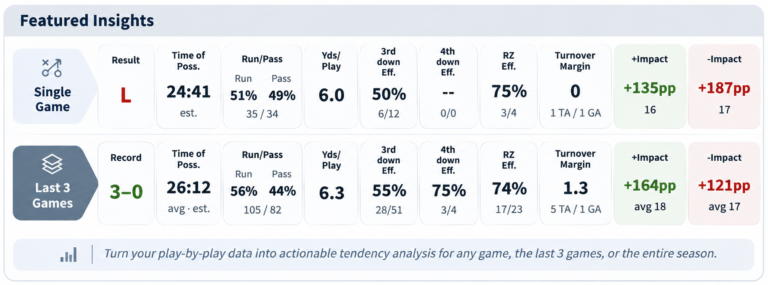
The examples above are just a small sample of what we uncovered from this team’s actual play-by-play data.
And because they’re preparing for the playoffs, we’re keeping the more revealing findings to ourselves.
What’s also worth mentioning is that the team didn’t have to chart additional plays, enter new data, or do anything extra. We took their existing play-by-play data and turned it into insights they can use.
By analyzing individual games or any combination of games, we can identify strengths, weaknesses, and recurring tendencies across offense, defense, and special teams – broken down by down, field position, and game situation.
Are we consistently struggling in certain situations? What tendencies might our next opponent reveal? Are the adjustments we’re making actually improving our performance?
Sometimes the right perspective is one game. Sometimes it’s the last three games. Sometimes it’s the entire season.
The goal isn’t to revisit every mistake. It’s to identify where improvement can make the biggest difference.
For teams heading into the playoffs, those lessons can sharpen preparation for the next opponent. For teams whose seasons are ending, they can help establish priorities for next season.
Stats tell us what happened. Film shows us how. Analytics help us understand how much it mattered.
Whether you’re preparing for the playoffs or preparing for next season, don’t let the lessons from this season go to waste.
Want to see what more you can learn from your team’s play-by-play data? Reach out – happy to take a look.
Analytics Inform. Coaches Decide.