
Week 18 - Analytics of 8 Key Decisions in Ole Miss vs. Georgia
Happy New Year!
Last week, we looked at the five-year NFL trend in field goal and punt attempts (Week 17).
This week we zoom in – using the College Football Playoff matchup between (#6) Ole Miss and (#3) Georgia, to explore key 2-PAT and 4th down decisions.
We’ll break down eight situations — not to second-guess, to instead highlight how analytics deliver proactive context and clarity when it matters most.
2nd Quarter
Ole Miss Special Teams

Scoreboard (i): Q2 10:33 | Ole Miss leading by 5 (12-7)
Required Success Rate: 49%
After scoring a TD, Ole Miss is up by 5 points and attempts a 2-PAT. In this situation the required success rate is 49%. In other words, if Coach Golding believed his team could convert this 2-PAT 49% of the time or more then he made the correct decision, regardless of the play’s outcome.
3rd Quarter
Ole Miss Offense
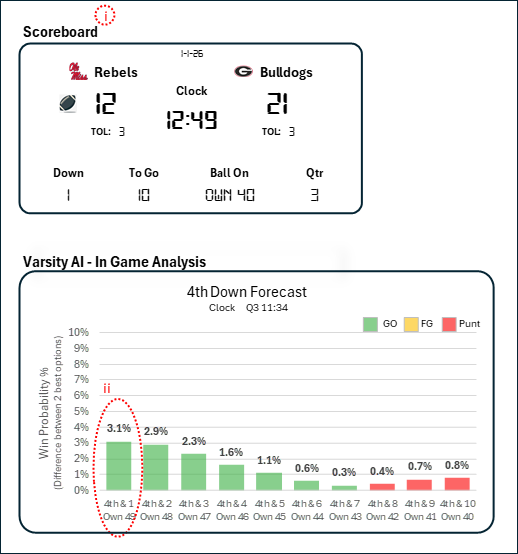
Scoreboard (i): Q3 12:49 | 1st & 10 Ball on Ole Miss 40 | Ole Miss trailing by 9 (12-21)
On this 1st down…
- If Ole Miss ends up facing 4th & 7 or less, going for it is the recommended decision (green bars).
- If Ole Miss ends up facing 4th & 8 or more, punting is the recommended decision (red bars).
- Ole Miss ends up facing 4th & 1 and going for it. (ii)
- Go for it → 16.3% chance to go on to win the game
- Punt → 13.2% chance to go on to win the game
- +3.1% decision edge for going for it (value above 4th & 1 bar)
Ole Miss Offense
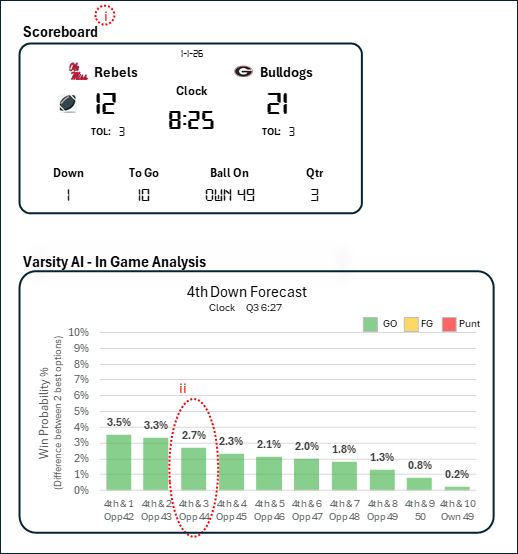
Scoreboard (i): Q3 8:25 | 1st & 10 Ball on Ole Miss 49 | Ole Miss trailing by 9 (12-21)
On this 1st down…
- If Ole Miss ends up facing 4th & 10 or less, going for it is the recommended decision (green bars).
- Ole Miss ends up facing 4th & 3 and going for it. (ii)
- Go for it → 15.2% chance to go on to win the game
- Punt → 12.5% chance to go on to win the game
- +2.7% decision edge for going for it (value above 4th & 3 bar)
It’s also worth noting that in this series (and in the previous series) the Ole Miss win probability was hovering around 15%, making it even more critical to make decisions that give them the best chance to mount a comeback.
Georgia Special Teams/Offense
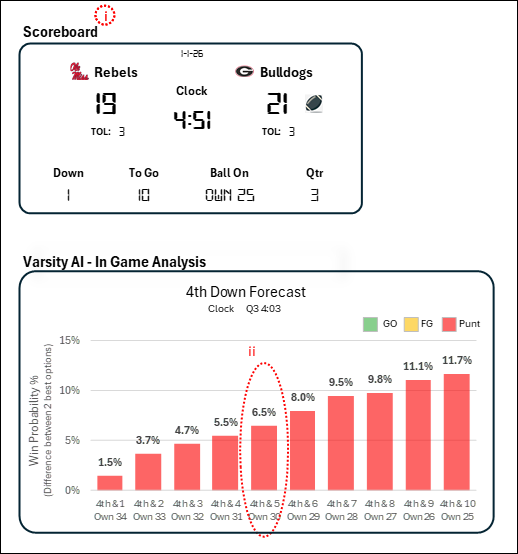
Scoreboard (i): Q3 4:51 | 1st & 10 Ball on Georgia 25 | Georgia leading by 2 (21-19)
On this 1st down…
- For Georgia, at all 4th down distances the recommended decision is to punt (red bars).
- Georgia ends up facing 4th & 5. This is a “hard Punt“— the best option by a margin of more than 5%. (ii)
- Punt → 65.4% chance to go on to win the game
- Go for it → 58.9% chance to go on to win the game
- +6.5% decision edge for punting (value above 4th & 5 bar)
- Georgia ends up attempting a fake punt/going for it and converting. Through the lens of analytics this was a suboptimal decision because it wasn’t the one that gave them the best chance to go on to win the game. This is a also great reminder that analytics don’t replace coaching, they support it by providing context. In other words, if you’re going to make these decisions you should know their magnitude.
4th Quarter
Ole Miss Special Teams

Scoreboard (i): Q4 11:29 | Ole Miss leading by 1 (25-24)
Required Success Rate: 38%
After scoring a TD, Ole Miss is up by 1 point and attempts a 2-PAT. In this situation the required success rate is 38%. So, if Coach Golding believed his team could convert this 2-PAT 38% of the time or more then he made the correct decision, regardless of the play’s outcome.
Georgia Offense
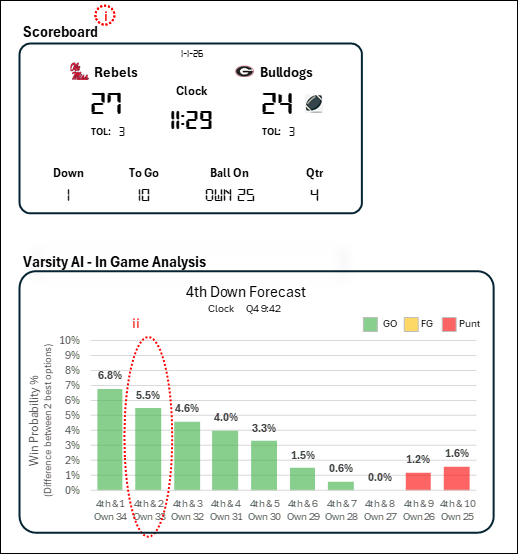
Scoreboard (i): Q4 11:29 | 1st & 10 Ball on Georgia 25 | Georgia trailing by 3 (24-27)
On this 1st down…
- If Georgia ends up facing 4th & 7 or less, going for it is the recommended decision (green bars).
- If Georgia ends up facing 4th & 9 or more, punting is the recommended decision (red bars).
- Georgia ends up facing 4th & 2. This is a “hard GO” — the best option by a margin of more than 5%. (ii)
- Go for it → 33.2% chance to go on to win the game
- Punt → 27.7% chance to go on to win the game
- +5.5% decision edge for going for it (value above 4th & 2 bar)
- Georgia ends up going for it and failing to convert. The best decision doesn’t always lead to a successfully executed play. Every play has two parts: the decision and the execution. For the decision piece, the goal is to make the ones that give your team the best chance to win the game — and that’s exactly what Coach Smart did.
Georgia Offense
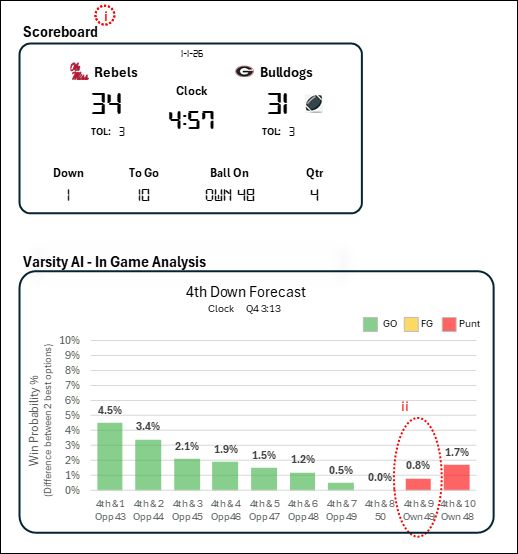
Scoreboard (i): Q4 4:57 | 1st & 10 Ball on Georgia 48 | Georgia trailing by 3 (31-34)
On this 1st down…
- If Georgia ends up facing 4th & 7 or less, going for it is the recommended decision (green bars).
- If Georgia ends up facing 4th & 9 or more, punting is the recommended decision (red bars).
- Georgia ends up facing 4th & 9 and going for it. (ii)
- Punt → 26.5% chance to go on to win the game
- Go for it → 25.7% chance to go on to win the game
- +0.8% decision edge for punting (value above 4th & 9 bar)
- This is a “coin-flip” – punting is the best option by a margin of less than 1%. The analytics support a decision to punt or go for it because the decision edge is so small.
Georgia Offense
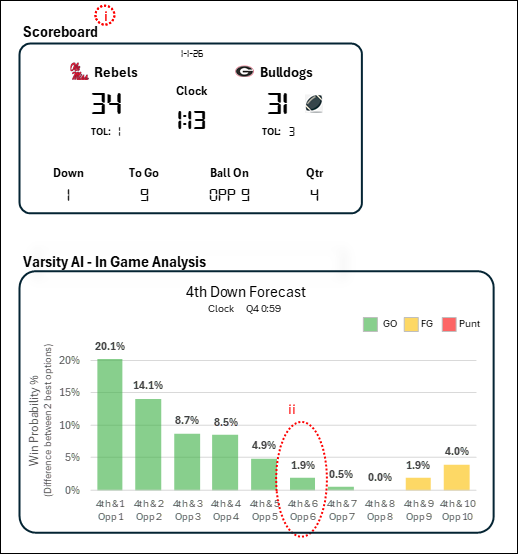
Scoreboard (i): Q4 1:13 | 1st & goal Ball on Ole Miss 9 | Georgia trailing by 3 (31-34)
On this 1st down…
- If Georgia ends up facing 4th & 7 or less, going for it is the recommended decision (green bars). 4th & 4 or less is a “hard GO” and the decision edges for 4th & 1 (+20.1%) and 4th & 2 (+14.1%) are huge!
- If Georgia ends up facing 4th & 9 or more, attempting a field goal is the recommended decision (yellow bars).
- Georgia ends up facing 4th & 6 and attempting a FG. (ii)
- Go for it → 33.6% chance to go on to win the game
- Attempt FG → 31.7% chance to go on to win the game
- +1.9% decision edge for going for it (value above 4th & 6 bar)
This isn’t playing results – analytics are proactively picking up on several critical factors…
- If Georgia attempts and converts a FG, Ole Miss will get possession with around a minute remaining and no timeouts, but an Ole Miss field goal will likely win the game. Ole Miss can also get to overtime by running out the clock.
- If Georgia scores a touchdown, Ole Miss will need to do the same.
Having this context on 1st down is critical to making the decisions that give your team the best chance to win the game!
 The Point:
In-game decisions don’t happen in a vacuum. They happen as high-pressure, ever-changing situations — and analytics support coaching with context and clarity when it matters most.
That means…
- Understanding the why behind the best decision — not just the result
- Seeing “decisions edges” before they matter
- Making confident, informed decisions that reflect game flow and matchups
At Varsity AI, we specialize in football analytics for high school, college, and NFL coaches!
Please reach out with questions. aj@varsity-ai.com